The Problem
A jewellery ecommerce client's order to cash process was manual end to end: staff created invoices by hand in Xero, chased payment links separately, and updated order status only after someone remembered to check. Every order touched three disconnected systems with no shared state: the cost wasn't the individual tools, it was the human being the integration layer between all of them.
Architecture
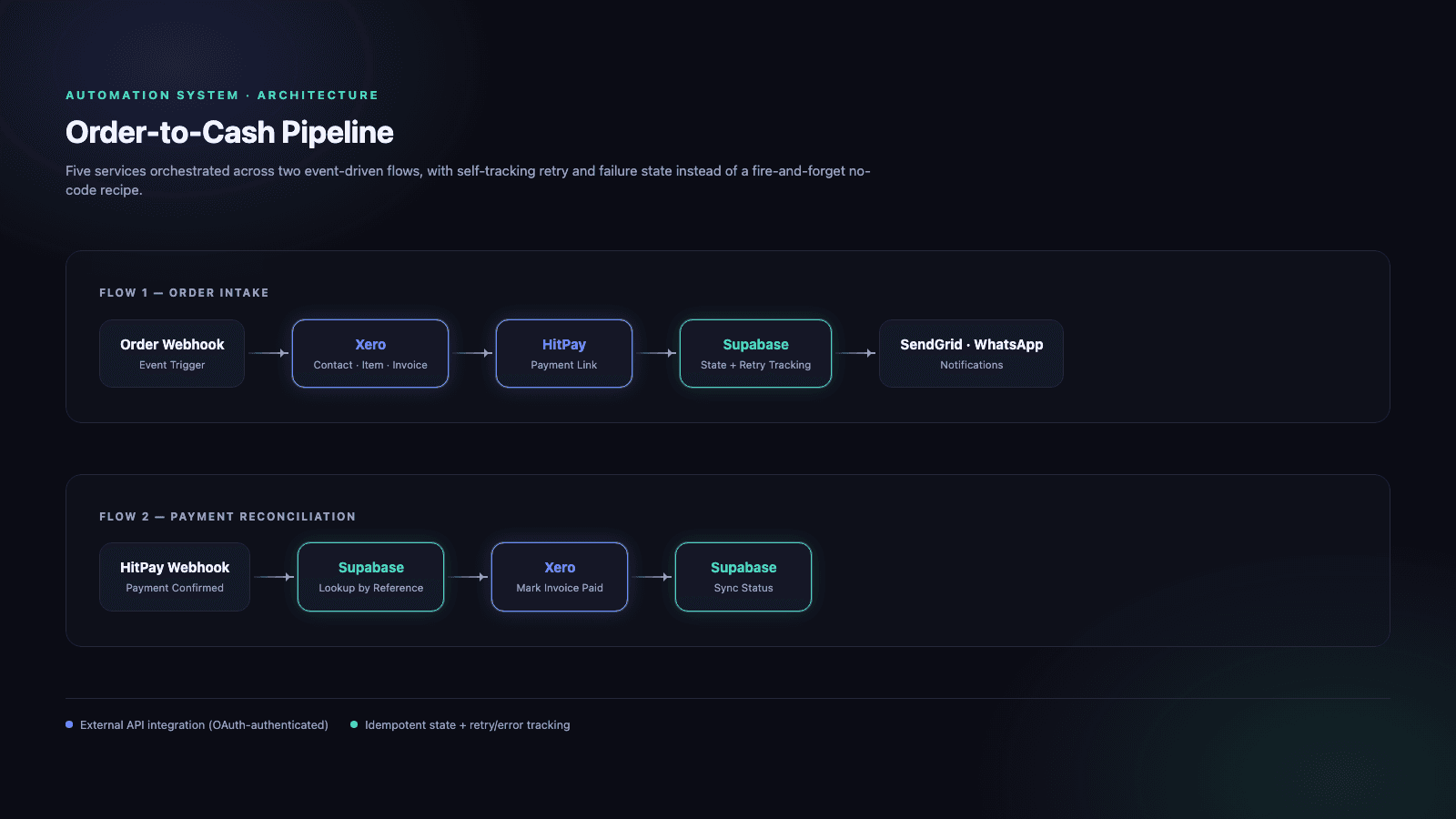
Order flow: Order Webhook → Xero (Contact · Item · Invoice) → HitPay (Payment Link) → Supabase (State + Retry Tracking) → SendGrid · WhatsApp
Payment reconciliation flow: HitPay Webhook → Supabase Lookup → Xero (Mark Paid) → Supabase Sync
What I Built
Idempotent multi service orchestration: a single order event fans out to contact lookup/creation, item matching, and deposit or balance invoice logic in Xero, then a HitPay payment link, without double charging or duplicating records on retry.
Self tracking failure state: every sync writes its own status, attempt count, and last error back to Supabase (sync_status / attempts / last_error), so a failed step is visible and resumable instead of silently lost: the kind of observability a stock automation recipe doesn't give you for free.
Payment to invoice reconciliation: a second, independent flow listens for HitPay payment webhooks, looks up the matching order in Supabase, marks the Xero invoice paid, and syncs status back: closing the loop without manual bookkeeping.
Branded, multichannel notifications: order confirmations, deposit/balance invoices, and payment reminders go out over email and WhatsApp from the same event, keeping the customer and the client's team in sync automatically.
Engineering Focus
The visual canvas is the interface, not the hard part. The real engineering is in the same places it would be in hand written code: API auth (Xero OAuth), idempotency on retry, and a data model that survives partial failure across five external services.
Why It Matters
The client went from a person manually bridging three tools per order to a system that reconciles itself. That's the differentiator over typical no code automation work: production reliability, not just a working demo.
Gallery