The Problem
Sales reps drafting quotes manually means retyping product names and prices from a catalog into a document, one line item at a time, with pricing accuracy resting entirely on the rep remembering the current list price. It's slow and it's exactly the kind of error prone, repetitive lookup work automation should own.
Architecture
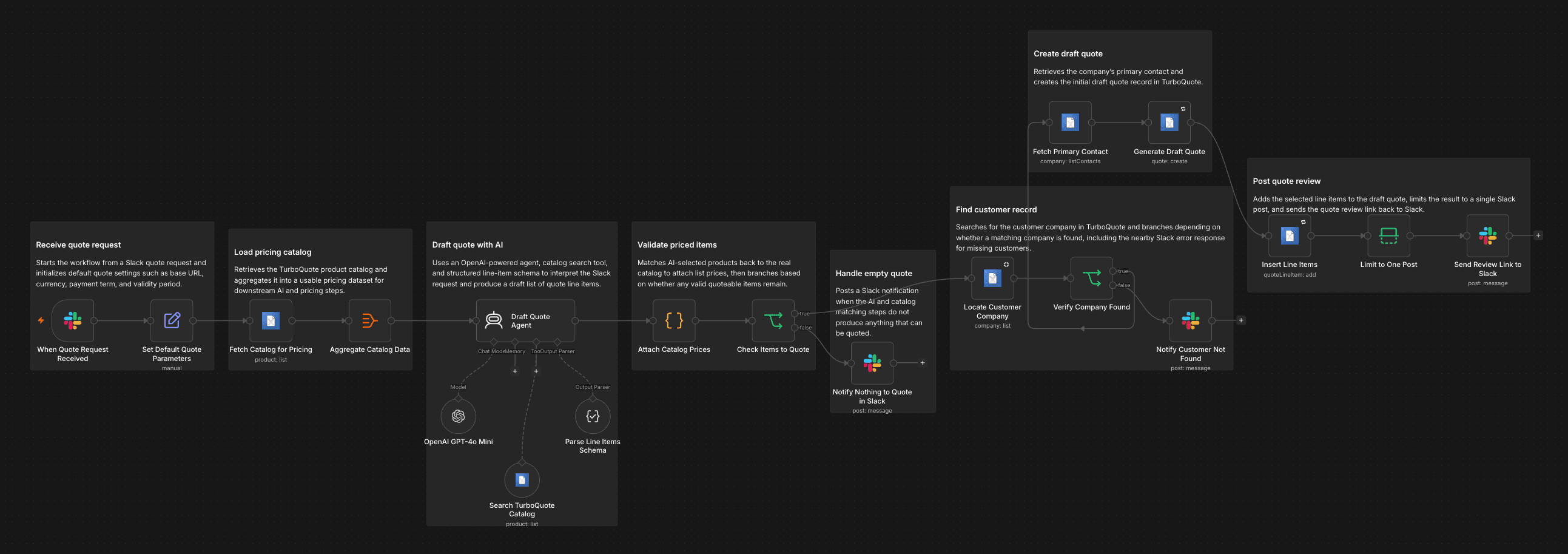
Slack @mention → Load TurboQuote Catalog → OpenAI Agent (extract customer + requested items, catalog search) → Join Selected Products Back to Authoritative Prices → [priced items exist: find customer + contact] → Create Draft Quote + Line Items → Post Quote Number/Total/Review Link to Slack
What It Does
AI does extraction, code does pricing: the OpenAI agent's job is narrow: parse the Slack message into a customer name and a list of requested items, and match those items against the catalog by search. The actual price attachment and total calculation happen in a deterministic join back to the authoritative catalog data, not inside the model's output.
Unmatched items are surfaced, not silently dropped: items the agent couldn't confidently match to a catalog product are tracked separately rather than omitted from the quote without explanation, so a rep sees what needs manual attention.
Fails visibly, not silently: if nothing priced correctly, or the customer company can't be found in TurboQuote, the workflow posts an explicit error back to Slack instead of producing a broken or empty quote.
Stays inside the tool people already use: the entire interaction is a Slack mention in, a quote link back; no separate quoting UI a rep has to context switch into.
Engineering Focus
The design worth studying is the separation between "let the LLM parse ambiguous natural language" and "never let the LLM compute a price." Extraction is a good LLM task; multiplying unit price by quantity is not: routing the actual math through a deterministic catalog join is what keeps this trustworthy for anything customer facing.
What I'd Harden
Before trusting this with real customer quotes I'd want: a confidence threshold on product matching (a fuzzy catalog match below some bar should ask for confirmation, not autoinclude), an audit log linking every generated quote back to the Slack message that triggered it, and a review gate before a quote is marked send ready: this workflow drafts, it shouldn't finalize unsupervised.
Gallery