The Problem
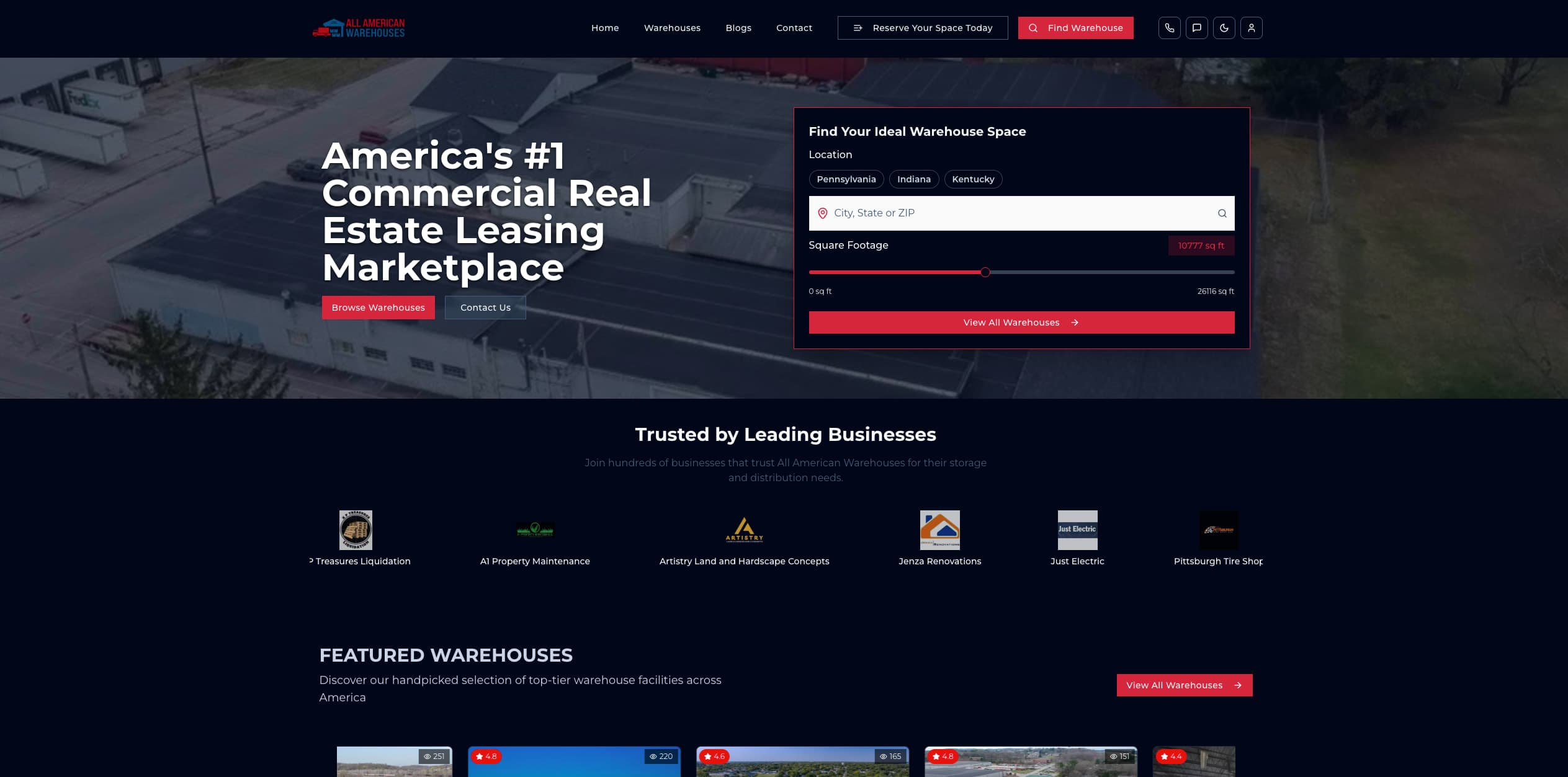
All American Warehouse ran an industrial real estate marketplace on Webflow and had hit its ceiling. Every listing change was a manual edit through a cumbersome editor; inventory was scattered across the company site and third party channels; and there was no structured path from "I found a warehouse" to "I'm speaking with sales." Most limiting of all, routine updates required a developer: the business couldn't publish, reprice, or restructure a page without technical help. For a catalog at industrial scale, that developer dependency was the real bottleneck.
Architecture
Next.js (SSR + ISR) → Strapi CMS (PostgreSQL) → Algolia index (resynced on publish) → Faceted search + map UI → Inquiry funnel → Nickel Payments
Content lives in Strapi; every publish reindexes Algolia; the Next.js front end renders listings with incremental regeneration and hydrates search and map client side.
What I Built
Typo tolerant Algolia search: faceted filtering by warehouse features, location, and size across the full catalog, with the index resynced on every Strapi publish so results never go stale. Chosen deliberately: industrial buyers type messy queries and expect instant, forgiving results.
A Strapi CMS the staff actually operate: I modeled the content types (listings, pages, a market insights blog) so nontechnical staff manage everything themselves. This is the change that mattered most; it removed the developer from the day to day loop entirely.
Inquiry to payment funnel: a unified reservation and contact path wired into Nickel Payments, turning discovery into a structured, trackable inquiry instead of a dead end contact form.
ISR + SEO first rendering: server rendered, structured listing pages with incremental regeneration, so the catalog stays fast and fresh while indexing cleanly.
Zero downtime migration: cut over from Webflow to Next.js + Strapi while preserving URLs and SEO, with staff training and documentation handed off at launch.
Engineering Focus
The hard part wasn't any single feature: it was decoupling content from code. Once listings lived in Strapi and relevance lived in Algolia, the marketing site became a thin, fast rendering layer the business fully controls. The search architecture followed the same principle: index on publish, keep the front end stateless, and let Algolia own typo tolerance and ranking rather than hand rolling it.
Results
Delivery timeline is exact; operational figures are directional estimates.
- Delivered in 8 weeks, kickoff to production.
- Listing publishing: ~1 to 2 day developer turnaround → minutes, self serve: the team no longer files a ticket to change its own content.
- Sub second faceted search across the full industrial catalog.
- Zero downtime migration off Webflow with URLs and SEO preserved.
- Estimated double digit % of content ops time reclaimed, now that edits skip engineering entirely.
Why It Matters
The client stopped paying a developer tax on its own content. Search that tolerates how people actually type, listings the team edits in minutes, and an inquiry path that ends in a payment: shipped in 8 weeks and handed off clean.
Screenshot