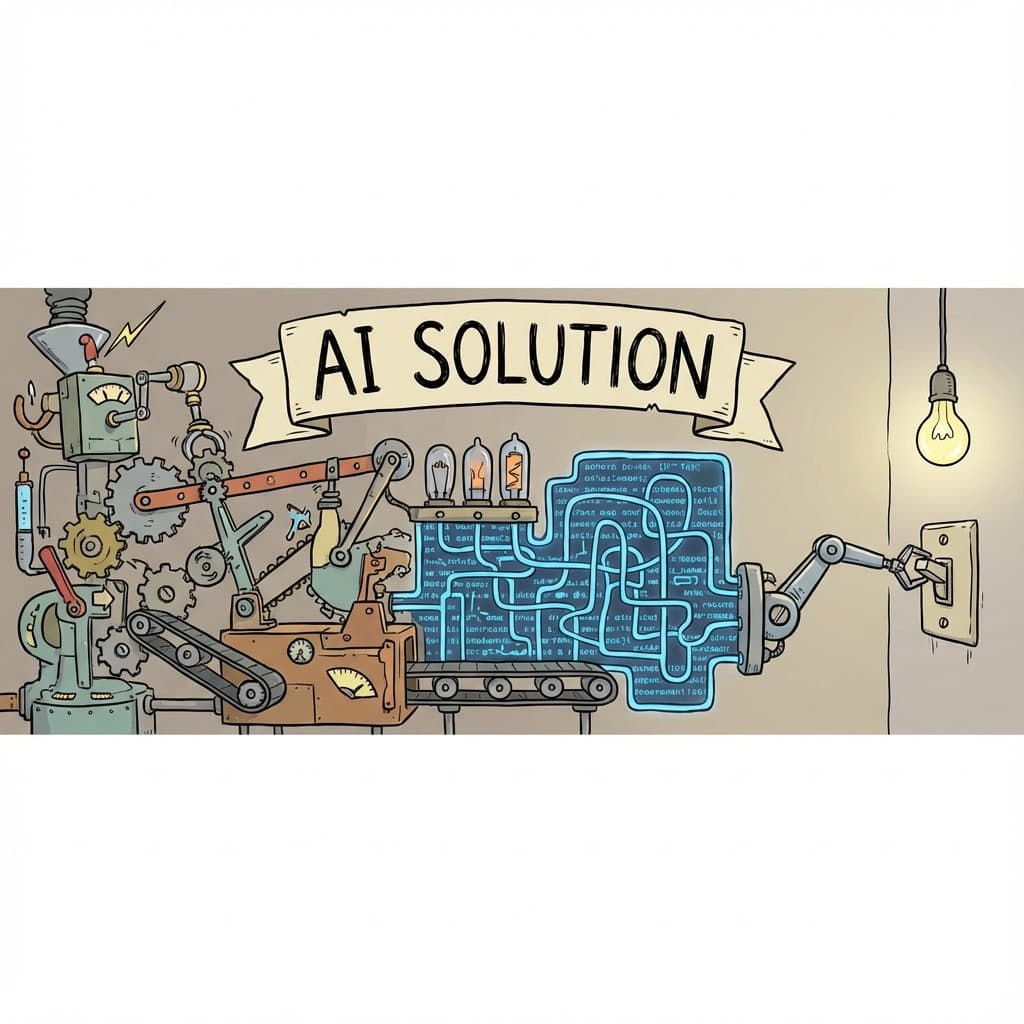
This is a cautionary tale about the time I trusted an AI and it straight-up lied to my face.
📦 The Phantom Library
I was building a form system. I asked AI:
"What's the best lightweight form validation library for React in 2025?"
AI responded confidently:
"I recommend
react-super-forms. It's lightweight, has great TypeScript support, and is very popular. Install it withnpm install react-super-forms@latest."
Sounds perfect! I ran:
npm install react-super-forms@latest
npm ERR! 404 Not Found
Okay, maybe I mistyped. I tried again. I Googled it. I searched npm.
This library does not exist.
The AI made it up. Invented it. Hallucinated a package name, description, and npm command for something that has never existed.
And it was SO confident about it. It had that energy of a person who definitely watched the documentary and is ready to explain the whole thing to you at a party.
(Narrator: He Googled it only after npm failed. This could have been avoided.)
🧠 What is Hallucination?
AI "hallucination" is when the model generates plausible-sounding bullshit.
Did you know? LLMs don't "know" facts. They predict what text should come next based on patterns. When you ask for "the best library for X," the model predicts what a helpful answer would look like. If it hasn't seen the answer, it generates one that sounds right.
The problem: sounding right and BEING right are not the same thing.
🎯 The Danger Zones
Where hallucinations love to hide:
📚 Niche Libraries
The more obscure the tool, the less training data exists, the more likely AI will just... invent.
📅 Recent Information
If it happened after the training cutoff, AI doesn't know. But it might pretend it does, with full enthusiasm.
🔢 Specific Numbers
Dates, versions, statistics, prices—AI makes these up while maintaining perfect eye contact.
⚖️ Legal/Medical Info
Please, for the love of all that is holy, do not trust AI for these. The hallucination risk is too damn high.
🔍 How to Protect Yourself
1. Verify Everything
If AI gives you a library name, Google it before installing. If AI gives you a fact, check a primary source.
I didn't verify. I npm installed a ghost. Learn from my mistakes.
2. Ask for Sources
"Can you provide a link to the documentation?"
If the link is broken or doesn't exist, congratulations! You caught a hallucination. 🎉
3. Notice Confidence Without Evidence
AI will tell you false things with the confidence of a Wikipedia editor who has never been wrong.
If the answer is very confident but has no citations or caveats, be suspicious.
4. Test Before Trusting
Never deploy AI-generated code without running it first. If it hallucinates a library, it'll fail at install. If it hallucinates logic, it'll fail at runtime.
📊 Trust Calibration
AI isn't "always right" or "always wrong." It's on a spectrum:
| Task | AI Reliability |
|---|---|
| Common syntax | ✅ Very high |
| Popular libraries | ✅ High |
| Niche packages | ⚠️ Medium |
| Recent news | ❌ Low |
| Specific numbers | ❌ Very low |
Calibrate your trust accordingly.
🎬 The Moral
AI is a powerful tool. I use it every day. I'm using it right now.
But I also verify every. single. thing. it tells me.
Because the moment you stop checking is the moment you deploy a library that doesn't exist into production.
And then you get to explain to your PM why the build failed because of a ghost. 👻
Trust, but verify. Always.