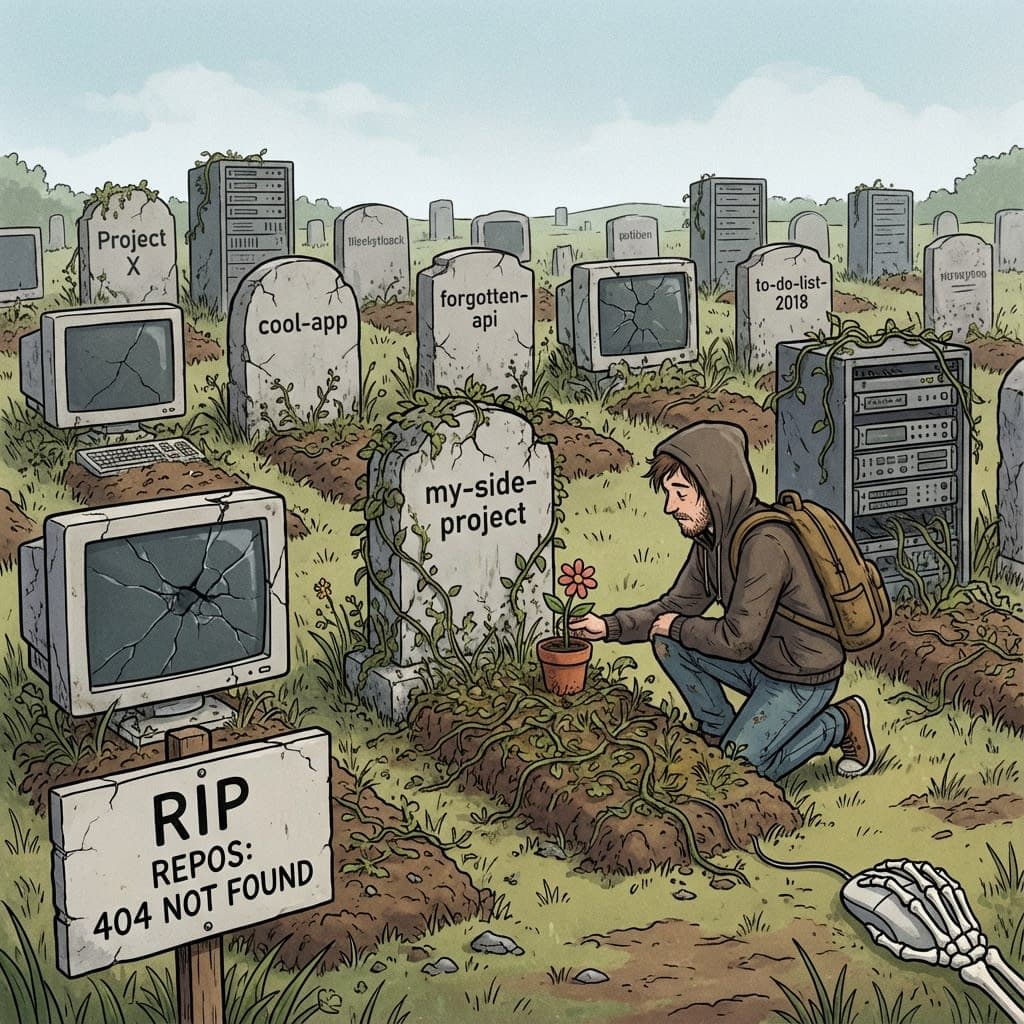
Let me introduce you to my shame folder.
It's called /Projects/abandoned/ and it contains:
- A to-do app (revolutionary, I know)
- A "better" Twitter clone (this was before the Elon era; it aged like milk)
- A cryptocurrency tracker (definitely aged like milk)
- 47 other optimistic README.md files with no actual code
- Multiple
.gitignorefiles for projects that never had anything worth ignoring
I used to feel bad about this. Then I learned the truth. 🪦
📊 The Graveyard Statistics
Did you know? A study of GitHub found:
- 93% of repositories have fewer than 10 stars
- 80% haven't had a commit in over a year
- 95% of projects never get a single contributor beyond the creator
Your abandoned side project isn't a failure. It's statistically normal.
🎭 The Lifecycle of a Side Project
Day 1: "This is THE idea. This will change everything." Creates repo. Writes elaborate README. Dreams of ProductHunt.
Day 3: "Core functionality coming together. I'm a genius." Actually builds something.
Day 7: "Hmm, this is harder than I thought." Stack Overflow usage intensifies.
Day 14: "I'll get back to it next weekend." You will not.
Day 365: "What even was this?" Finds repo. Doesn't remember the password to the associated dev account. Considers this an acceptable form of loss.
🎯 Why Projects Die
| Reason | Percentage |
|---|---|
| Lost interest | 40% |
| Got too hard | 25% |
| Life happened | 20% |
| Found a better idea | 10% |
| Actually finished (rare) | 5% |
Did you know? The same pattern applies to professional developers AND hobbyists. Even experienced devs have project graveyards. It's not a skill issue—it's a human issue.
🧠 The Guilt Problem
We're taught that:
- "Finish what you start"
- "Winners never quit"
- "Discipline beats motivation"
So when we abandon projects, we feel like failures.
But here's the thing: side projects aren't jobs.
You're not being paid. You don't owe anyone anything. If it stopped being fun or valuable, why force it?
✅ Why Abandonment is Actually Good
1. You Learned Something
Even failed projects teach:
- A new technology
- Why an idea won't work
- What you don't want to build
Learning happened. Value was created. The project doesn't need to ship.
2. You Made Room for Better Ideas
Every abandoned project frees mental space for the next one.
Some of those "next ones" will actually ship.
3. You Filtered What Matters
Starting 10 projects and finishing 1 isn't a 10% success rate.
It's a 100% success rate at finding what you actually care about enough to finish.
🔥 The Controversial Take
Maybe you shouldn't finish your side project.
Maybe it was:
- A weekend experiment (done!)
- A learning exercise (done!)
- An idea you needed to get out of your head (done!)
Not everything needs to be a product. Not everything needs to be maintained forever.
📁 How to Abandon Gracefully
If you're going to abandon (and you will), do it well:
- Archive the repo — Not delete. Future you might want it.
- Write a "lessons learned" note — Future you will thank you.
- Don't apologize — "This project is unmaintained" is fine. No guilt.
- Cannibalize the good parts — That auth flow you built? Use it elsewhere.
🎯 The Bottom Line
Your /abandoned/ folder isn't a graveyard of failures.
It's a museum of experiments.
Some experiments work. Most don't. That's literally how science operates.
The only real failure is never starting anything because you're afraid of not finishing.
Start things. Abandon most of them. Finish the ones that matter.
And stop feeling guilty about the rest. We all have the folder. 🪦