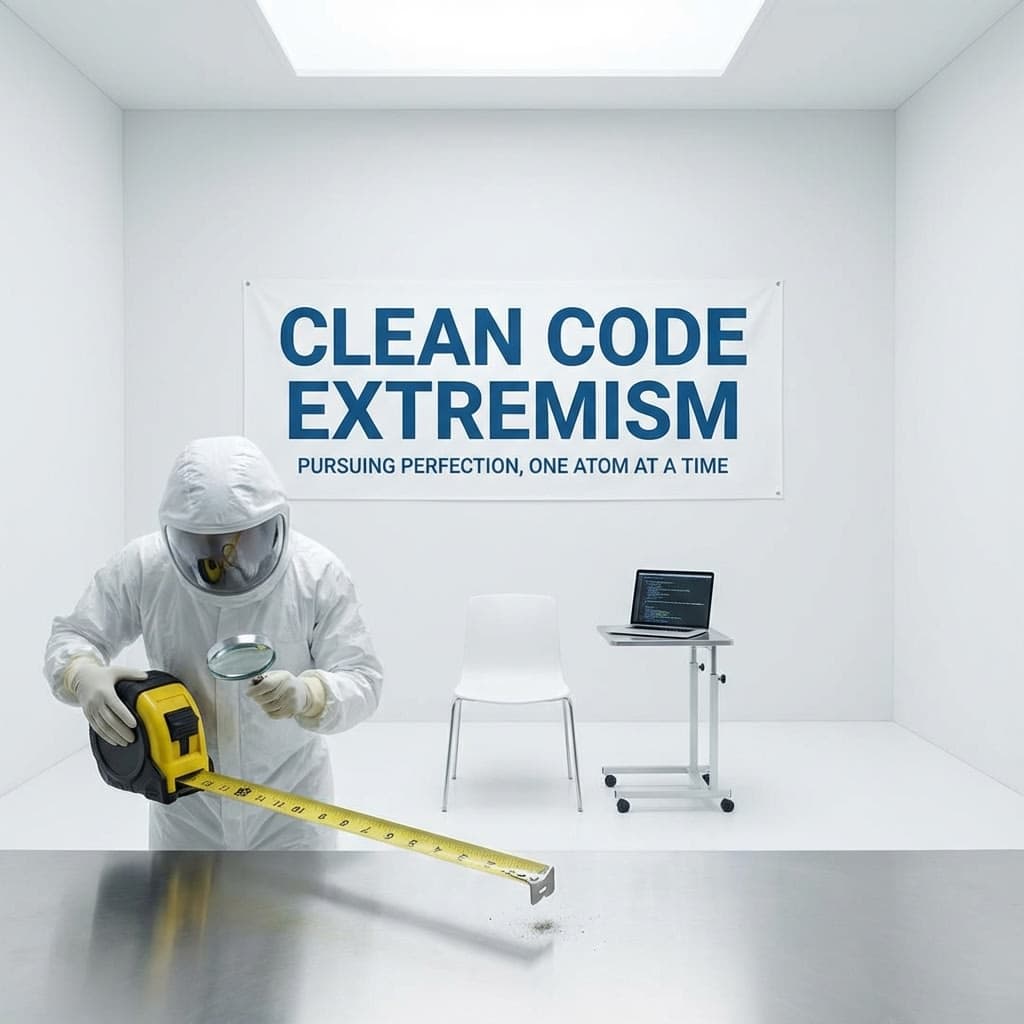
Let me tell you about the cleanest codebase I ever saw.
Perfect abstraction. Every function under 10 lines. SOLID principles everywhere. 100% test coverage.
It took 6 months to build a login page.
The project was cancelled. 🪦
📿 The Church of Clean Code
Somewhere along the way, "writing good code" became "following rules religiously."
The commandments:
- Thou shalt not repeat thyself (DRY)
- Thou shalt have one responsibility per function (SRP)
- Thou shalt abstract early and often
- Thou shalt achieve 100% test coverage
- Thou shalt never use
anyin TypeScript
And look, these are good guidelines. I apply them.
But when they become religion, we get absurdity.
Did you know? The original "Clean Code" book by Uncle Bob is great. But some developers treat it like a sacred text where every word is law. Uncle Bob himself has said people take it too far.
🎪 The Absurdity Examples
Example 1: DRY to Death
The code:
// Used in 2 places
const formatDate = (date) => date.toLocaleDateString();
The "clean" refactor:
// date-utils.ts
export const createDateFormatter =
  (options = {}) =>
  (date) =>
    date.toLocaleDateString(options.locale, options);

// date-formatter-factory.ts
export const getDefaultDateFormatter = () => createDateFormatter({});

// constants/date.ts
export const DATE_FORMAT_OPTIONS = { locale: 'en-US' };
We went from 1 line to 3 files because "what if we need flexibility later?"
We won't. We didn't. The feature got deprecated.
Example 2: Abstraction Astronautics
What we needed: Fetch user data.
What we built:
- UserRepositoryInterface
- UserRepositoryImpl
- UserService
- UserServiceImpl
- UserFacade
- UserController
- UserDTO
- UserMapper
- UserFactory
For a call that hits one endpoint and returns JSON.
Did you know? This pattern is called "Astronaut Architecture"—built for flexibility that will never be used, at massive complexity cost.
Example 3: The Test Coverage Trap
"We need 100% test coverage!"
So we write tests like:
test('returns true when condition is true', () => {
  expect(isTrue(true)).toBe(true);
});
Congratulations. You've tested that JavaScript works.
Meanwhile, the actual business logic has bugs because we spent all our time writing meaningless tests.
🔥 The Controversial Takes
Take 1: Some Repetition is Fine
Copy-pasting code 2-3 times isn't a crime. If the uses diverge later, you didn't over-abstract.
Take 2: Premature Abstraction is Worse Than Duplication
You know what's harder than duplicated code? Wrong abstraction that everything depends on.
Take 3: "Clean" is Subjective
What's "clean" to you is "over-engineered" to someone else. Stop pretending there's one truth.
Take 4: Shipping > Purity
A messy feature that helps users is better than perfect code that never ships.
Take 5: Test Coverage Numbers Are Vanity Metrics
80% of the bugs come from untested edge cases in the 20% of code that's hard to test. 100% coverage is a feel-good number.
📊 The Actual Balance
| Extreme | Problem | Better Approach |
|---|---|---|
| No standards | Chaos, bugs, unmaintainable | Have guidelines |
| Religious adherence | Slow, over-engineered | Guidelines, not laws |
| Zero tests | Regressions, fear | Test critical paths |
| 100% coverage | Wasted time, false confidence | Test what matters |
🧘 My Approach Now
- Make it work — Ship something
- Make it right — Refactor when patterns emerge
- Make it fast — Optimize when needed
Notice "clean" isn't a step. It's a byproduct of iteration, not a goal in itself.
🎯 The Bottom Line
Clean code principles are TOOLS. Not commandments.
Tools serve the work. When the religion serves itself, we've lost the plot.
The goal is: Ship valuable software that works.
Not: Satisfy abstract principles while users wait forever.
When code review becomes theology debates instead of "does this solve the problem?"—you've joined a cult.
I'm not saying be sloppy. I'm saying be pragmatic.
Now if you'll excuse me, I have a feature to ship. Even if it's not perfectly SOLID. 🚀